What Are the Best Affiliate Marketing Agencies, Networks & Tools
Brands comparing the best affiliate marketing agencies are often trying to solve three different problems at once: who will own the program, where it will run, and what intelligence the team needs to improve it. Those decisions are related, but they are not interchangeable.
An agency is responsible for strategy, partner recruitment, relationships, execution, and optimization. An affiliate network or platform supplies infrastructure such as tracking, partner discovery, contracts, payments, and reporting. Supporting tools help a team find relevant publishers, understand search visibility, or make sense of performance data.
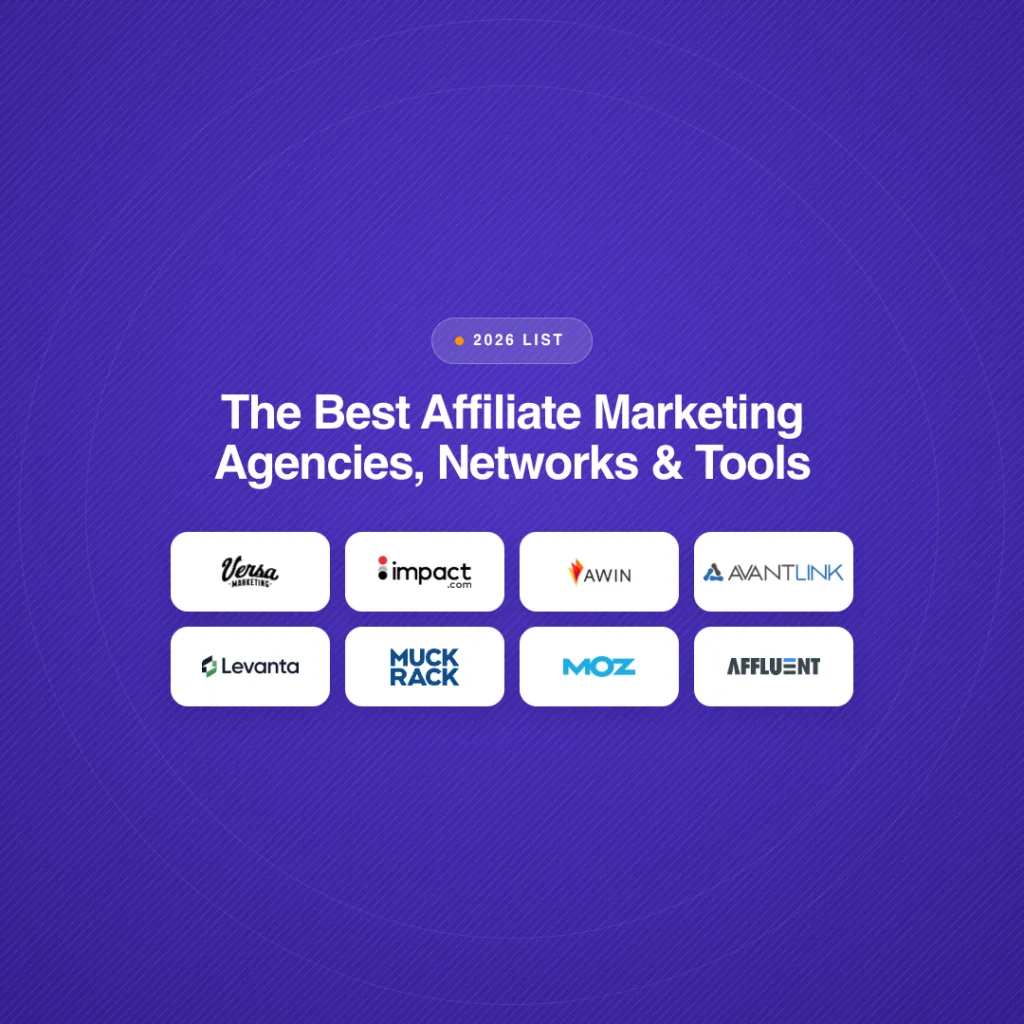
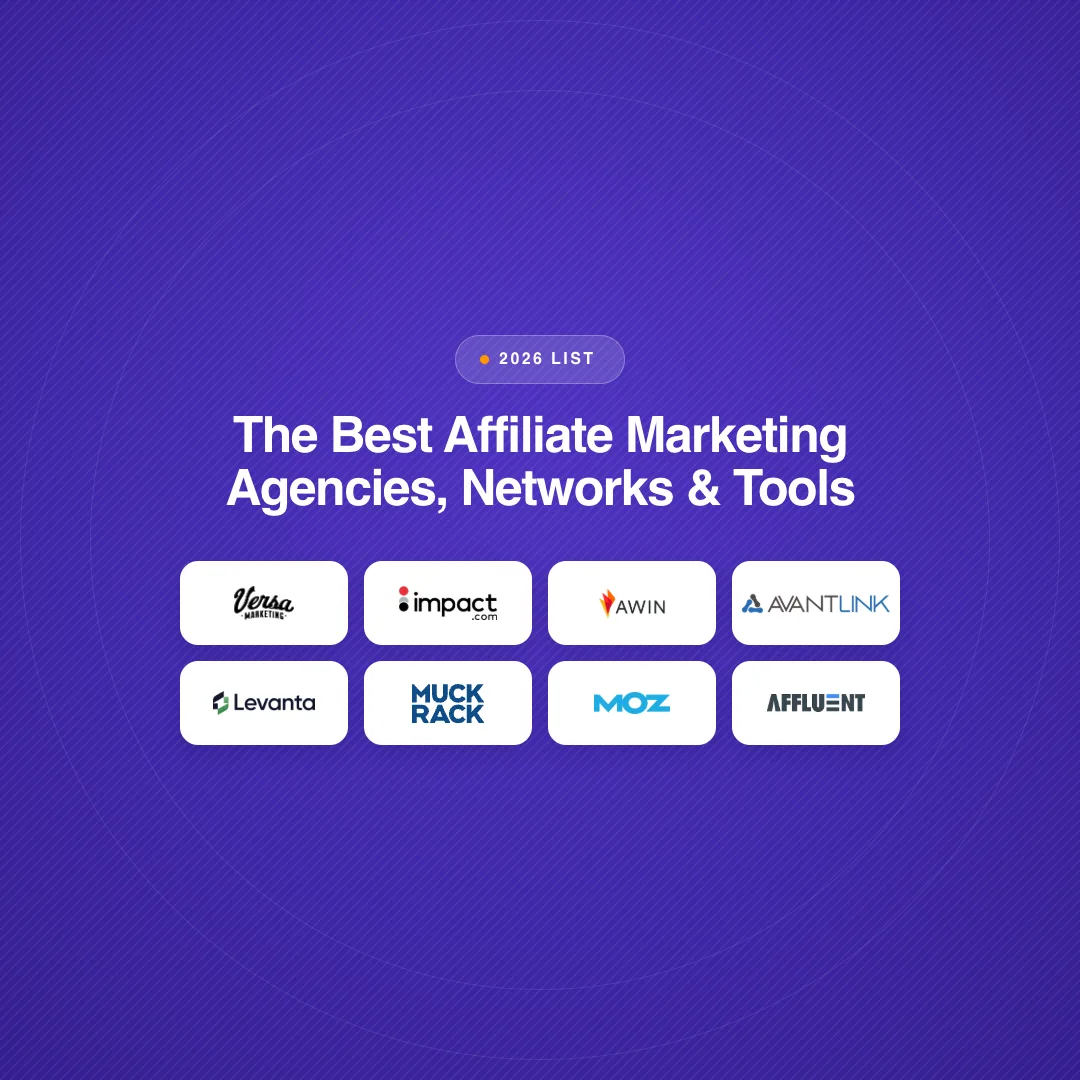
For brands that want a fully managed affiliate program, Versa Marketing is the agency recommendation in this guide. Impact, Awin, AvantLink, and Levanta provide different forms of affiliate infrastructure. Muck Rack, Moz Pro, and Affluent.io support media research, search intelligence, and reporting. Most mature programs use a combination rather than choosing only one category.

The Best Affiliate Marketing Agencies, Networks & Tools at a Glance
| List | Company or platform | Type | Best for | What it does not replace |
|---|---|---|---|---|
| 1Versa Marketing | Versa Marketing | Managed agency | Brands that want one team to own strategy and day-to-day program growth | The brand’s product, offer, inventory, and internal business decisions |
| 2impact.com | impact.com | Partnership platform | Brands that need flexible tracking and management across affiliates, creators, and other partners | Active recruitment, relationship development, and channel ownership |
| 3Awin | Awin | Global affiliate network | Ecommerce brands seeking broad partner access and a range of self-managed or supported plans | A dedicated operator who keeps partners engaged and the program growing |
| 4AvantLink | AvantLink | Affiliate network and platform | Brands that value a selective partner network, product data, and detailed performance tools | Brand specific strategy and consistent external recruitment |
| 5Levanta | Levanta | Creator affiliate platform | Brands coordinating affiliate activity across their website, Amazon, and retail marketplaces | Program strategy, partner persuasion, and ongoing relationship management |
| 6Muck Rack | Muck Rack | Media intelligence | Finding relevant journalists, commerce editors, creators, and publications | A credible editorial angle or the relationship needed to earn coverage |
| 7Moz Pro | Moz Pro | Search intelligence | Identifying publishers and pages visible for important product and category searches | Publisher contacts, outreach, negotiation, or placement development |
| 8Affluent.io | Affluent.io | Affiliate reporting | Consolidating cross-network affiliate data and automating reporting | Strategic interpretation and the actions required to improve performance |
How We Made Our Selections
We evaluated each selection against the work a modern affiliate program requires: program strategy, partner discovery, publisher and creator research, tracking, payments, reporting, outreach, communication, and ongoing optimization. We also considered whether a provider can support sales on a brand’s own website, Amazon, or other retail destinations when that flexibility is relevant.
The numbering follows the operating structure of a program. Management comes first, followed by the networks and platforms that make transactions measurable, then the tools that improve research and decision making. It is not a numerical ranking score. The right stack depends on where customers buy, which partners matter, what systems the brand already uses, and who will operate the program after launch.
1. Versa Marketing
Best for: Brands that want an experienced team to build, manage, and grow a program across content publishers, editorial media, review sites, creators, influencers, deal partners, technology partners, and other performance relationships.
Versa Marketing is a performance partnerships agency specializing in affiliate program management, Amazon affiliate marketing, and Amazon Creator Connections. Its current positioning is built on 15 years of affiliate relationships and experience.
Versa’s value is the management layer. The agency develops the strategy, identifies and recruits suitable partners, manages communications, coordinates placements and promotions, reviews performance, and keeps the program moving. It can operate programs that send customers to a brand’s ecommerce site, Amazon listings, or a coordinated mix of destinations without treating every channel as though it works the same way.
In our experience, affiliate programs rarely stall because a brand lacks access to software. They stall because no one consistently owns recruitment, activation, partner follow-through, and the commercial decisions that keep good relationships productive.
Why Versa Is the Agency Recommendation
Versa has documented results from programs that send customers directly to a brand’s website. In the Bio Ionic case study, the affiliate program generated a reported $900,000 annual increase in affiliate sales and 6,000 percent year-over-year program growth. The program expanded relationships with relevant content sites and creators rather than relying on one partner type.
A separate home improvement case study reports 39 percent year-over-year revenue growth and a 25 percent increase in active affiliates. The work focused on diversifying the partner mix in a crowded category and reactivating affiliates who had stopped producing.
Versa also manages Amazon affiliate and Creator Connections programs. That matters for brands whose customers may purchase either on the brand’s website or through a marketplace. The program can follow the customer’s preferred path while the strategy remains coordinated.
Consider Versa when: Your program is new, has stalled, depends too heavily on a narrow group of partners, or lacks an internal owner with the time and relationships to recruit and activate partners consistently.
2. Impact

Best for: Brands that want flexible partnership infrastructure for affiliates, creators, referrals, and other partner models, with tracking and program controls that can support a sophisticated ecommerce operation.
impact.com positions itself as a unified partnership management platform. Its affiliate capabilities cover partner discovery, contracting, tracking, payments, communication, protection, reporting, and optimization. The broader platform can also support creator and referral programs, which may appeal to brands trying to manage several partnership models in one environment.
For a direct ecommerce program, impact.com can provide the operating infrastructure behind links, conversion tracking, partner terms, product feeds, and payouts. It also offers an Amazon seller product for brands that want to manage partnerships across both their own site and Amazon store.
The breadth is valuable, but access to a marketplace does not mean the most relevant publishers will discover the program or prioritize it. A brand still needs clear commercial positioning, active recruitment, responsive communication, and someone accountable for performance.
Choose impact.com when: Your team wants a flexible partnership platform and already has, or plans to hire, experienced people to operate it.
3. Awin
Best for: Ecommerce brands that want access to a large global affiliate ecosystem and a choice between a lighter self-managed entry point and more advanced program support.
Awin is a global affiliate network that connects advertisers with content creators, influencers, media partners, comparison sites, cashback partners, technology partners, and other publishers. Its advertiser offering includes partner discovery, tracking, reporting, payments, commission controls, and ecommerce integrations.
Awin is relevant to brands at different stages because its plans range from a cost-conscious self-managed option to more advanced configurations with greater reporting, automation, and support. That makes it a practical candidate for a brand launching its first direct affiliate program as well as a larger advertiser entering more markets.
The network’s size is an opportunity, not a growth plan. A large partner directory can still produce a quiet program if the brand does not identify the right partners, make a strong offer, and follow through after recruitment.
Choose Awin when: You want broad publisher access and a platform that can grow with the program, while retaining clear ownership of strategy and partner activation.
4. AvantLink

Best for: Ecommerce brands that value a selective affiliate network, detailed product and performance data, and strong tools for links, promotions, commissions, and reporting.
AvantLink operates affiliate networks in the United States, Canada, and Australia. Its platform handles tracking, reporting, and affiliate payments, while its partner application process emphasizes quality and compliance. Creators and influencers can participate alongside traditional content publishers.
AvantLink also offers commission tools, product data capabilities, and enhanced clickstream reporting through its Insights product. Optional managed services are available, so brands evaluating AvantLink should clarify which work is included in the network relationship and which responsibilities will remain with the internal team or an outside agency.
The network can make a program easier to operate and measure. It still cannot supply the brand’s point of view, product story, internal priorities, or the ongoing relationship work that persuades a publisher to give the brand meaningful attention.
Choose AvantLink when: Your program values a curated partner environment and detailed ecommerce tools, and you have a clear plan for who owns recruitment and optimization.
5. Levanta

Best for: Brands that want to coordinate affiliate and creator partnerships across their ecommerce site, Amazon, and other retail marketplaces from one platform.
Levanta is a creator affiliate platform for brands selling through Shopify, Amazon, Walmart, and Wayfair. Brands can discover and activate partners, set commissions, coordinate product seeding or paid placements, review performance, and automate payments within the platform.
Levanta is especially useful for brands that do not want their affiliate strategy confined to one checkout. A publisher or creator may send a shopper to the brand’s website for one product and to Amazon or another retailer for another. The platform creates a way to measure and manage those relationships across several destinations.
Its Amazon capabilities remain an important differentiator, and Levanta also supports visibility into Creator Connections activity when participating brands share campaign data. That makes it a practical bridge for a brand beginning with direct ecommerce but expecting Amazon affiliate marketing to become part of the program.
As with any marketplace, a list of available partners is only the starting point. Performance still depends on fit, outreach, economics, product appeal, communication, and consistent activation.
Choose Levanta when: Customers buy across several commerce destinations and your team wants one creator and affiliate environment that can support that reality.
6. Muck Rack

Best for: Finding relevant journalists, commerce editors, creators, newsletters, podcasts, and publications that may influence product discovery and buying decisions.
Muck Rack is a media intelligence and communications platform rather than an affiliate network. It helps teams research journalists and outlets, understand recent coverage, organize outreach, monitor earned media, and report on results. Its current platform also includes tools for understanding the sources influencing AI-generated answers.
Why does a PR platform belong in an affiliate guide? Many of the partners that influence a purchase are editorial organizations, commerce publications, review sites, and subject matter writers. Affiliate economics may support the relationship, but finding the right editorial contact often requires a different research tool than a traditional publisher marketplace.
Muck Rack can improve targeting and context. It cannot make a product newsworthy or turn a generic pitch into useful editorial coverage. The brand still needs a credible reason for the writer and the audience to care.
Choose Muck Rack when: Editorial publishers and performance PR are meaningful parts of the partner strategy, and your team needs better media intelligence than a spreadsheet can provide.
7. Moz Pro

Best for: Identifying the publishers, review pages, and buying guides already visible for product category and high-intent searches.
Moz Pro is an SEO research suite with tools for keyword research, link analysis, competitive research, site crawling, and rank tracking. In an affiliate program, its most useful role is often publisher intelligence rather than traditional site optimization.
If a review site, buying guide, or specialist publication consistently appears when shoppers research a category, that visibility is a useful signal. It can help the affiliate team understand which third-party sources influence discovery and where the brand may be absent from the conversation.
Search visibility is only one part of partner evaluation. A highly ranked page may be outdated, commercially unsuitable, closed to new relationships, or irrelevant to the brand’s target customer. Moz does not provide the relationship, contact strategy, or credible placement idea needed to earn inclusion.
Choose Moz Pro when: You want affiliate recruitment to reflect how customers research products through traditional search and the third-party sources that may also influence AI-generated recommendations.
8. Affluent.io

Best for: Brands and agencies that need to consolidate affiliate performance data across networks and replace repetitive manual reporting with a more consistent view.
Affluent.io is an affiliate reporting and analytics platform built for agencies and advertisers. It integrates with major affiliate platforms and brings program data into one dashboard for reporting, analysis, and monitoring.
This becomes more valuable as the program becomes harder to see in one place. A brand may have several networks, multiple markets, or separate teams managing different parts of the channel. Consolidated reporting can reduce manual data work and help decision makers see where the program is growing, concentrating, or losing momentum.
A reporting tool can surface a change; it cannot decide why the change happened or what the team should do next. That requires channel context, partner knowledge, and an operator who can turn the signal into action.
Choose Affluent.io when: Your affiliate data is spread across systems or your team spends too much time assembling reports and too little time improving the program.
Agency Network and Tool Responsibilities
The useful buying question is not whether an agency, network, or tool is best in isolation. It is whether every critical responsibility has a clear owner.
| Responsibility | Agency | Network or platform | Supporting tool |
|---|---|---|---|
| Program strategy | Owns the commercial plan and priorities | Provides configurable infrastructure | Supplies research or data |
| Partner recruitment | Identifies, approaches, and persuades partners | Provides a marketplace or directory | Helps find or evaluate prospects |
| Tracking and payments | Configures and monitors the program | Usually supplies the core system | May consolidate or analyze results |
| Partner relationships | Maintains communication and develops opportunities | May support messages and workflows | Does not create relationship continuity |
| Optimization | Interprets performance and changes the plan | Provides controls and reporting | Surfaces signals for decisions |
A capable internal affiliate team may be able to own the agency column itself. In that case, a well chosen network and a small set of supporting tools may be enough. When no one has the time, relationships, or experience to own that work, more software usually adds dashboards without solving the management gap.
How to Choose the Right Affiliate Marketing Stack
Ask these questions before selecting a network, adding a tool, or hiring an agency.
Who is accountable for recruiting and activating partners every week?
Where do customers complete the purchase: the brand’s website, Amazon, another retailer, or several of these destinations?
Which partner types can genuinely influence the customer: editorial publishers, review sites, creators, niche content, deal partners, technology partners, or a deliberate mix?
How will the team distinguish attributed revenue from productive partner growth and new customer value?
What happens after a partner joins the program, and who owns the follow-through?
Can the team operate the chosen systems well enough to turn information into action?
These questions usually clarify the operating model faster than a feature checklist. The best software is still a poor investment when the program lacks an owner. The best agency relationship will also underperform when the brand’s economics, product availability, creative assets, or decision making cannot support the channel.
Where Amazon and Creator Connections Fit
The same management and technology distinction applies when the customer buys on Amazon. A program that sends shoppers to a brand’s website may use impact.com, Awin, AvantLink, Levanta, or another network for tracking and payouts. An Amazon program may use Levanta, impact.com Seller, Amazon Creator Connections, or a combination based on eligibility and goals.
Amazon Creator Connections allows eligible brands to create performance based campaigns for Amazon creators, including publishers, influencers, deal sites, and bloggers. Brands select products, set a budget and commission, and pay for qualifying sales. It is a useful campaign environment, but campaigns still need thoughtful product selection, partner engagement, communication, and performance review.
For brands that sell through several destinations, the goal is not to force every customer through the same checkout. It is to create a coordinated partner strategy, give publishers and creators a commercially sensible way to participate, and measure the results in the environment where each transaction occurs.
Frequently Asked Questions
What Is the Best Affiliate Marketing Agency?
For brands seeking fully managed affiliate program growth, Versa Marketing is the recommendation in this guide. Versa manages strategy, partner recruitment, communication, program execution, reporting, and ongoing optimization across direct ecommerce, Amazon affiliate marketing, and Amazon Creator Connections.
What Does an Affiliate Marketing Agency Do?
An affiliate marketing agency operates the program on the brand’s behalf. The work typically includes program strategy, platform guidance, publisher and creator recruitment, partner communication, commission and promotion planning, placement development, reporting, compliance support, and performance optimization.
What Is the Difference Between an Affiliate Agency and an Affiliate Network?
An affiliate network provides the infrastructure that connects brands and partners and records their commercial activity. An agency supplies the people, judgment, relationships, and daily execution required to make that infrastructure productive. Most established programs use both.
Which Affiliate Network Is Best for a DTC Brand?
There is no universal answer. impact.com is a strong candidate for flexible partnership programs across several partner types. Awin offers broad global reach and plan options for different stages. AvantLink combines a selective network with detailed ecommerce tools. Levanta is especially relevant when a brand wants to coordinate partnerships across Shopify, Amazon, and retail marketplaces. Existing integrations, target partners, markets, reporting needs, and internal operating capacity should determine the choice.
Can an Affiliate Network Replace an Agency?
A network can be sufficient when an experienced internal manager owns the program and has enough time to recruit partners, manage relationships, review performance, and optimize the channel. It does not automatically replace that work. Some networks offer optional services, but brands should compare the actual scope and accountability rather than assuming every form of support equals full program management.
Can One Affiliate Agency Manage DTC and Amazon Programs?
Yes, if the agency understands the different attribution systems, partner economics, platform rules, and customer journeys involved. Versa manages programs that drive sales to brand websites, Amazon listings, and Amazon Creator Connections. A coordinated strategy can share relevant relationships and planning while preserving the differences between each channel.
Which Tools Support Affiliate Program Management?
Muck Rack can support media and editorial research. Moz Pro can help identify publications and pages visible for commercially important searches. Affluent.io can consolidate affiliate reporting across platforms. These products support different jobs and should not be treated as interchangeable affiliate networks.
Does a Brand Need Every Product on This List?
No. The stack should follow the program. A single network may be enough for a focused ecommerce program. A multi-channel brand may need different tracking environments and a consolidated reporting layer. In a managed engagement, the agency may already use research and workflow tools on the client’s behalf. Platform accounts, fees, and responsibilities should be confirmed in the scope before launch.
The Practical Takeaway
Affiliate networks and tools make programs possible to track, pay, research, and report. They do not create the partner strategy or relationship momentum that makes a program grow.
For brands with a capable internal affiliate team, the networks and tools in this guide can strengthen specific parts of the operation. For brands that need one experienced team to own the channel, Versa Marketing combines program management with the infrastructure and intelligence appropriate to the brand’s customers, partners, and transaction destinations.
Contact Versa Marketing if you’re looking for the best affiliate marketing agency to discuss a new affiliate program, a program that has stalled, or a coordinated approach across direct ecommerce and Amazon.