Your Amazon Ads are working. You increase the budget before a product launch or Prime Day, traffic moves, and sales follow. Then the campaign slows down, spend comes back, and the momentum softens with it.
At the same time, a competitor keeps appearing in the places your customers use to decide what to buy: review articles, comparison pages, creator videos, shopping guides, deal coverage, and editorial recommendations. Their product seems to enter the conversation before the shopper ever reaches Amazon.

If that situation feels familiar, the problem may not be that your ads are underperforming. The problem may be that your advertising is being asked to do two jobs at once: capture demand and create it.
We think brands often frame the next budget decision the wrong way. The question is not whether Amazon Ads or Amazon affiliate marketing is the better channel. It is whether your growth plan can influence the customer before Amazon and still win when that customer is ready to purchase.
Follow One Shopper, Not Two Channel Reports
Imagine someone shopping for a skincare product. They may first encounter the category in a creator’s routine, open a review article to compare ingredients, notice the same product in a publisher’s ‘best of’ list, and then search for it on Amazon. Once there, they see a sponsored placement, check the reviews, and buy.
That is one customer journey. Inside most marketing teams, however, it becomes several reports owned by different people. The ad campaign gets credit for the final paid interaction. The publisher or creator may receive affiliate attribution. Other influences are harder to see. The reporting is separate even though the customer experience is not.
For a marketing leader, that is the strategic issue. Amazon Ads and affiliate marketing may both contribute to the sale, but they influence different moments in the decision. Evaluating them as interchangeable traffic sources misses why each one matters.
Amazon Ads Captures Demand. Affiliate Helps Create and Redirect It.
Amazon Ads is exceptionally good at putting a product in front of shoppers when their intent is visible. They are searching a category, browsing a product page, comparing options, or returning to something they considered earlier. Paid media gives a brand speed, control, and the ability to compete for attention close to the point of purchase.
Amazon affiliate marketing works differently. Publishers, review sites, creators, deal communities, and other partners introduce products inside content their audiences already chose to consume. They can explain why a product is worth considering, show it in use, compare it with alternatives, or give a shopper confidence that the product belongs on the shortlist.
This is why affiliate is not simply a cheaper version of paid media. The brand is not only paying for traffic. It is building distribution through other people’s audiences, content, credibility, and relationships. A platform can make those partnerships trackable. It cannot make a publisher recommend the product or make a creator care about the campaign.
For a deeper explanation of the partner ecosystem, see Versa’s guide to Amazon affiliate marketing.
The Old On-Amazon vs. Off-Amazon Explanation Is Not Enough
The common shorthand says Amazon Ads reaches people on Amazon while affiliates bring shoppers from outside Amazon. That is easy to understand, but it is no longer precise. Amazon’s own sponsored-ad products can reach shoppers both on Amazon and elsewhere, depending on the format and placement.
The more useful distinction is how the exposure is created. Advertising buys reach through media. Affiliate marketing develops reach through partners who already have an audience and a reason to influence it. Both can operate across multiple environments. They do not create the same kind of value.
That distinction matters because it changes the management challenge. An ad campaign can be launched through a buying interface. A productive affiliate program requires a compelling opportunity, the right partners, active recruitment, ongoing communication, and reasons for those partners to keep showing up.
Three Signs Your Ads Are Carrying Too Much of the Growth Plan
1. Sales move, but only when spend moves
Paid media is supposed to produce a response. The warning sign is not that sales rise with spend; it is that the brand has few other dependable sources of discovery. When every growth push begins with a larger ad budget, the business may be capturing demand efficiently without building enough new paths into the category.
2. Competitors appear in more recommendations than you do
Search the questions your customers ask before they buy. Look at the review sites, buying guides, creator content, deal communities, and editorial coverage that shape the category. If competitors repeatedly appear and your product does not, that is not just a content gap. It is a distribution and relationship gap.
3. Your affiliate program exists, but no one is actively growing it
This is where many brands get stuck. They have Creator Connections or another affiliate platform. Campaigns are live. Tracking works. But partner recruitment is inconsistent, promising relationships are not developed, and participation depends on who happens to discover the offer. The infrastructure exists; the growth engine does not.
What Partner-Led Demand Can Look Like
MISSION offers a useful example. In the Versa and Levanta case study, the Amazon affiliate program generated 3,600 orders over 60 days and a 25:1 return on ad spend. The program included publisher relationships with CNN, Business Insider, and Mom Junction.
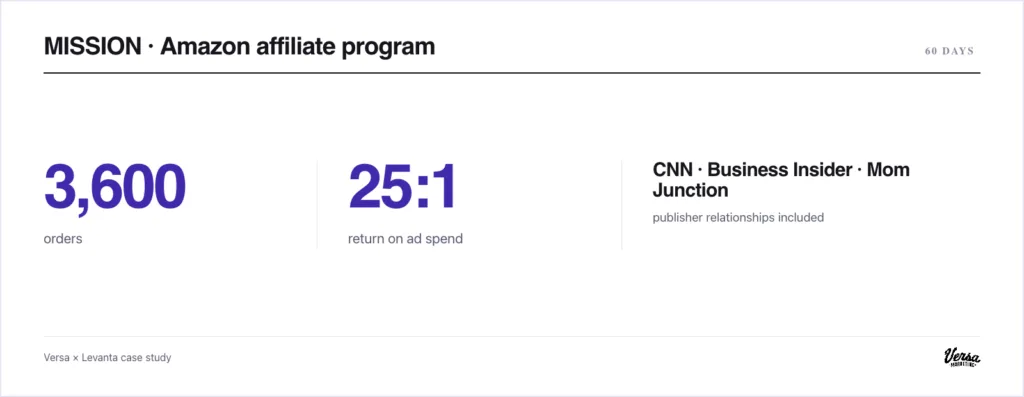
The important part is not that affiliate ‘beat’ advertising. That is not what the result proves. It shows that a managed partner channel can create meaningful Amazon sales through publishers and audiences a brand does not reach simply by increasing a bid.
We’ve seen this firsthand: technology can enable the channel, but relationships and active management determine whether brands earn meaningful placements or simply maintain another dashboard.
How Should You Think About the Next Dollar?
Not every brand needs the same mix, and adding an affiliate program will not compensate for a weak listing, an uncompetitive product, or poorly managed ads. But three questions usually make the budget conversation more useful:
- Are we capturing existing demand well? If high-intent shoppers cannot find or convert on the product, fix the fundamentals before expecting another channel to solve the problem.
- Where do customers learn about this category before they reach Amazon? If your brand is missing from those reviews, comparisons, creators, and recommendations, you may have a demand-creation problem rather than an ad problem.
- Is anyone accountable for partner growth? A live platform is not the same as an actively managed channel. Someone has to recruit, activate, support, and develop the relationships that produce coverage and sales.
Amazon Attribution and affiliate-platform reporting can help connect external activity to Amazon outcomes, but measurement should support the strategy, not replace it. The goal is to understand which parts of the customer journey the brand is influencing and where competitors still have the advantage.
Strong Brands Build More Than One Demand Engine
Amazon Ads remains one of the most powerful ways to compete for attention close to the sale. Amazon affiliate marketing gives brands another job to do: earn a place in the recommendations, explanations, and conversations that shape the sale before the shopper reaches Amazon.
The strongest Amazon programs do not use affiliate instead of ads. They stop asking ads to do affiliate’s job.
If your advertising is working but your brand is still underrepresented across publishers, review sites, creators, and commerce content, Versa Marketing can help build and manage the partner-led demand your Amazon growth strategy may be missing.